
I’ve been playing golf for years, and I’ve made every beginner mistake there is to make. I’ve watched the YouTube breakdowns at midnight, bought more gear than any reasonable person should admit to, and my wife calls this hobby “the money pit.” She’s not entirely wrong, though I’d argue the gear is the best part.
What all those years taught me is that the beginner golf mistakes that wreck your scorecard aren’t the ones people warn you about. The grip tips and swing tempo reminders are genuinely useful, though the real trouble spots are subtler, and nobody really hands you that list. Here are five of them, from a guy who learned every single one the hard way.
1. Playing the Wrong Ball
For a long time, I grabbed whatever ball I could find, including beat-up range balls, ones I’d fished out of the pond, and the occasional Pro V1 I convinced myself I deserved. The Pro V1s were a particularly bad idea.
Tour balls are engineered for players with fast swing speeds and dialed-in mechanics. For everyone else hacking around on a Saturday morning, all that extra spin just makes bad shots go worse. You’re paying four dollars a ball to be humiliated more spectacularly.
Match the Ball to Your Swing
Low-compression balls like the Callaway Supersoft, Srixon Soft Feel, or Titleist TruFeel are built for moderate swing speeds. They compress more easily at impact, so even mishits get a little more distance. More importantly, they produce less side spin, which means bad swings are merely bad instead of catastrophic.
I switched and immediately noticed my misses weren’t traveling quite as far into the trouble spots. The ball didn’t fix my swing, but it stopped making my swing look worse than it already is.
2. Spending an Hour Bombing Drivers at the Range
For years, I’d grab the biggest bucket available, spend 45 minutes bombing drivers, and head home convinced I’d done something productive. I’d shoot 98 on Saturday and spend the drive home completely baffled.
What makes this one of the most common beginner golf mistakes is the allocation. Mark Broadie’s strokes gained research, adopted by the PGA Tour, found that roughly two-thirds of scoring differences between golfers come from shots outside 100 yards. The long game matters more than most people think. But the remaining third, putting and chipping, matters far more than most beginners’ practice time reflects. If you’re spending 90% of your range time on the driver and 0% on your short game, the math doesn’t add up.
Work Backwards From the Green
Flip the whole session around. Start on the putting green, and spend 15 minutes on short putts from three to six feet. Then chip for a while, focusing on landing the ball in a specific spot. Then pitch shots, then mid-irons, then a few drivers if there’s still something left in the tank.
If you want to take your short game even further, we put together a dedicated short game guide with six ways to sharpen things up before summer.
3. Keeping Score Before You’re Ready for It
Obsessively tracking every stroke from round one nearly made me quit the game entirely. A rough front nine would snowball into a miserable back nine, and by the 15th hole, I was genuinely asking myself why I was spending my one free Saturday morning doing this.
When the score defines the whole experience, a bad round becomes a bad day. But bad rounds are the baseline for a beginner. Letting the score define every round is one of those golf mistakes that drives people away from the game entirely.
Track Something You Can Control
For your first several rounds, ditch the scorecard, and set two or three process goals before you tee off. Aim to hit at least four fairways, two-putt or better on six holes, and avoid three-putting altogether. Those are measurable targets you can feel good about, regardless of what the total looks like.
Also worth adopting is the double-par rule. If a hole is going completely off the rails, pick up your ball once you’ve hit double the par for that hole. Pace of play stays reasonable, your head clears, and the next tee gets a fresh start instead of inheriting the wreckage.

4. Trusting Your Best Shot Instead of Your Average One
Ask me how far I hit my seven-iron, and I’ll tell you about the one I hit last August, a dead-center strike that went 155 yards with a slight draw. I think about that shot more than I probably should. I also make club decisions based on it, which is the problem.
My honest seven-iron distance is closer to 130 on a normal swing. I spent years selecting clubs based on one magical shot instead of the other 200, and the result was a lot of approach shots that came up short while I blamed the wind.
Build a Yardage Card You Can Trust
Spend one range session tracking real numbers. Hit 10 balls with one club, throw out the two best and the two worst, and average the middle six. Write that number down. Do it for every club in your bag, and keep that card with you.
On the course, add one extra club to whatever your gut says. If the pin is 140 yards and your average seven-iron carries 130, hit the six. More balls will find the green, and finding the green more often changes the entire feel of a round.
5. Aiming at the Flag on Every Single Shot
For years, I aimed straight at the pin no matter where it was cut, no matter what trouble surrounded it. I was gambling on every approach shot without knowing it.
A beginner’s shot dispersion, meaning how far left or right the ball can go on a typical swing, is enormous. On a 150-yard shot, missing the center of the green by 20–30 feet in any direction is completely normal. Aim at a flag tucked near a bunker with that kind of spread, and you’re in the sand more often than you need to be.
Aim for the Fat of the Green
Make the center of the green your default target on every approach, regardless of where the flag is. The center gives you the most room for error in every direction, keeps you out of the worst trouble, and almost always leaves a manageable putt.
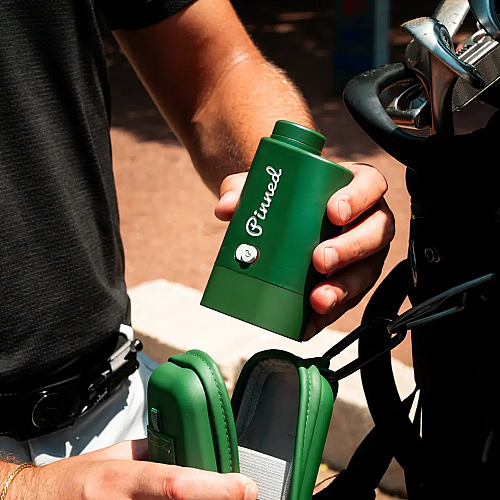
A rangefinder or GPS device makes this effortless because you can pull yardages to the front, center, and back of the green. Once I started using the center distance as my default, my greens-in-regulation numbers went up, and my scores came down.
Small Fixes, Fewer Wasted Rounds
None of this requires new equipment or a lesson or another 11 PM online order (though I can’t promise that last one won’t still happen). Most beginner golf mistakes are just habits, and habits are free to fix.
I’m still not the golfer I want to be, but I’m better than I was and having a lot more fun in the process. Small adjustments, made consistently, have a way of adding up fast.




Leave a Comment
Your email address will not be published. Required fields are marked *